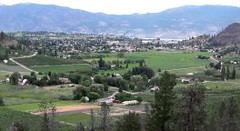
The following document was delivered to Mayor Gregory and all Councillors on Monday 12th June. It should be read in conjunction with the previous article on this site, called " The Perfect Project for Summerland – 14 Tests".
Summerland Hills AnalysisDesign and Financing.
The design is well thought out and professional. No public information is available on the extent and method of financing the project.
Compliance.
This proposal does not comply with the letter or with the spirit of the existing OCP. Early development in North Prairie Valley is at odds with the existing OCP, and with the Growth Management Policies in the Drafts of the new OCP.
Both documents plan for an orderly progression of development, short term and then long term. They designate the Urban Growth Area for near term development and North Prairie Valley for development in the longer term. If North Prairie Valley is opened for development now, then instead of having a short and long term plan, everything becomes short term. Council will have little to no ability to control the rate of development.
To quote UMA’s draft of the new OCP, "The first priority is the in-filling and redevelopment of land within the Urban Growth Area"
Early development in North Prairie Valley would represent a planning change from compact smart growth that maximises the use of existing infrastructure, to sprawl. If this project proceeds at an early date, growth will be deflected from in-filling and densification, and away from the "compact community" concept.
In the words of Ekistics staff at the recent Planning Advisory Commission hearing, "This will be
THE growth area for Summerland"
There is one other major difference between, on the one hand, the current OCP and the draft of the new OCP, and on the other hand the Summerland Hills plan. The OCP long-term plan was for close to 3000 homes in North Prairie Valley. Summerland Hills plans for 1100 homes. What is the long-term implication of this?
Is Summerland’s long-term population target now dramatically reduced?
or
Will the area eventually be redeveloped to a much higher density than the present plan?
or
Will more crown land be added to the Municipality, allowing the spread of housing out towards Faulder?
or
Will the agricultural land in Prairie Valley come under pressure to provide room for housing?
Highest and Best Use.No other proposals have been considered for this 1000 + acre tract of land, so there is no way of assessing the relative worth of this project.
The Carter proposal for the roughly 300 acres of municipal land which was until recently in the Agricultural Land Reserve is better from the employment perspective because it would create many agricultural, winery, tourism and retail jobs without increasing the population. It would also support and complement our existing agriculture and tourism industries, providing considerable additional income for Summerland with no risk - and without adding to Municipal operating costs.
One disturbing aspect of the Summerland Hills proposal is that it would put control of a large proportion of Summerland’s future growth in the hands of one group, severely limiting competition.
Smart GrowthIt is ironic that an aerial view of Summerland is used on the SmartGrowthBC website as the example of "keeping the town in the town and the country in the country" (with North Prairie Valley clearly shown as "country") whilst Summerland considers deflecting growth from the town to the country – i.e. into North Prairie Valley.
Growth Rate.If North Prairie Valley is opened up for immediate development then Council will create the potential for very rapid growth. No developer willingly waits 20 years to realise the profit on a project. Brandenberg, like other Californian developers, typically completes such developments in a few years.
A likely scenario is that development will proceed rapidly with some homes being sold to British Columbians and the majority being sold to Californians and Calgarians as holiday homes (as occurred in Invermere). A development designed by Californians, financed by Californians, and sold to Californians? This is similar to the situation in which Invermere finds itself.
According to a recent survey of Invermere residents the number one challenge their town faces is "controlling growth with year round residents, not a shadow population".
Quality of Life.
The construction of a third golf course will please the golfers in town. Those who presently enjoy unimpeded recreational access to the land in question will lose freedom, but those who prefer to walk in an urban setting will gain.
The majority of the population will see greatly increased traffic but no benefit.
Future Capital Expenditures.Long term consequent costs to the Community of the Summerland Hills development will not be covered unless Development Cost Charges are dramatically increased.
Summerland has a history of collecting inadequate Development Cost Charges for residential development. This is not just a local problem. Numerous North American studies reach the same conclusions.
Over the past 20 years Summerland’s population has increased by about 65%. This growth has made necessary major new capital expenditures in several areas. To no ones surprise, we now need a larger water supply (to name just one item) to serve the larger population.
The new developments created the need for more water. The DCCs levied over the past 20 years should have included several thousand dollars per home to go into a reserve to pay for the inevitable capital costs created by those developments.
Apparently that did not happen. Consequently the last and the current Council were each obliged to levy property tax surcharges on all residents to cover capital expenditures required as a result of relatively recent development. It is unreasonable and unfair to expect the current residents to attempt to raise money on demand, when the need for infrastructure was created by developers who will have taken their profits and departed.
At the present rates, DCCs received during the course of the entire development of Summerland Hills will total roughly $9,900,000. This is but a small fraction of the consequential long term capital costs to the community for increased water storage, road widenings and improvements, sewer system extensions and sewer treatment plant expansion, enlarged recreational facilities, enlarged police fire and library facilities, garbage dump move, new parks, and so on.
Municipal Operating Costs.
No information available. Snow fall in this area is well above average for the town as a whole, so snow removal costs will be disproportionately high, as will winter road damage expenses. Presumably items such as this will be taken into account when property taxes are calculated.
Existing Infrastructure.
Summerland Hills will make little use of existing infrastructure. Developing North Prairie Valley could deter development within the sewer-specified area thus delaying the "payback" on that expensive project.
By contrast the existing plan to infill and densify first within the sewer specified area, before expanding the town, makes excellent use of existing services.
We must have a drought management plan that deals with new development. Climate change studies are shifting into high gear and Summerland would be foolish to move quickly when making promises on water licenses and allocation. If we again go into a drought situation the insurance companies which sell to home owners and the agricultural community need to be assured of adequate water available during peak irrigation periods and fire season. The two go hand in hand.
Employment Ratio Impact.
Every construction project creates a boost in construction work. This does not justify any development. Our contractors have been working at full capacity for some years. They will continue to be fully employed with or without Summerland Hills.
What Summerland really needs is permanent, skilled employment opportunities. Highly paid professional jobs that will give young Summerlanders the opportunity to stay in Summerland should be the goal.
Summerland Hills would have a large negative impact on local employment, i.e. on the Jobs to Worker ratio, because it is primarily a large housing development. Whenever large numbers of new residents are brought into a community without corresponding permanent job creation, employment ratios suffer. Existing residents find it harder to get a decent job because of the increased competition.
Our present "worker per household" ratio with our present age demographics is 1.15 employed persons per home (Stats. Can 2001). The Summerland Hills development of 1100 new homes implies 1,300 new job seekers in Summerland – assuming the age demographics for the new development mirror the existing. The development could provide around 150 permanent jobs, the majority of them modestly paid and seasonal (chambermaid, golf course maintenance, etc.). This leads to four possibilities.
Either
a) The majority of owners will in fact be non-resident (holiday homes) so the adverse effect on unemployment figures will be mitigated (but that brings other negative effects – do we want to become a holiday community that partly closes down for much of the year? Do we want a transient population?)
or
b) The 1150 surplus workers will commute to Penticton or Kelowna.
or
c) A new industrial area will be needed in conjunction with this housing development to provide the other 1150 jobs. Where would it be located? What type of industry would be acceptable for Summerland?
or
d) Most of the new residents in Summerland Hills will be retired and will not need jobs (but would it be healthy for Summerland to have a much higher percentage of elderly citizens than it already has?)
Downtown Benefits.Our downtown is special, and deserves the best support we can give it.
Higher density housing within easy walking distance of town would provide the most support for our downtown businesses. Low density housing in North Prairie Valley (especially if owned by non-residents) would be much less beneficial to the downtown ("I’m already in the car, I might as well go on to Penticton").
A prime example again is Invermere, where hundreds of Calgarians arrive to spend the weekend in second homes, cars already loaded up with all they need for their stay.
Affordable housing.The project currently incorporates some multi-family housing, so some homes should be at the lower end of the price range. This is good. The problem is that the location makes it essential to use a vehicle on a daily basis, which will make it unaffordable for low-income families.
Parks.We presently have 485 acres of designated parks according to the Rec. Dept. This figure does not include the two golf courses, and does not include the North Prairie Valley area that is presently used as unofficial parkland by many residents. Our present population to parks ratio is approximately 24 residents per acre of park. The 1100 homes in Summerland Hills represents about 3,000 residents. 125 acres of new parkland would maintain the ratio.
Adherence to Proposal.It is unreasonable and irrational to expect the present development consortium to remain involved with this project for 20 years. The principals will be in their seventies, eighties and nineties by then. Logically they will either accelerate the project so they can see it through to completion and profitability within a much shorter timeframe, or they will sell out to another developer when the opportunity arises.
What controls should the Municipality have to temper the rate of growth?
What leverage could the Municipality have should a new developer take over the project and want to dramatically change direction? By then costly infrastructure will be in place and the Municipality will desperately need the new DCC and property tax income to repay the borrowing for the capital expenditures.